Written By Sarah Revie (Cuvalo)
“Eventually the system starts to tell the same story over and over again: that the problem is the person.”
People like to say the system is broken. But the truth is a lot harder to sit with than that.
Most of the time, the people deciding which programs receive funding have never worked in the field themselves. They have never held someone’s hand while they cried because they were banned from the one place they felt safe. They have never shouted someone’s name while they were overdosing and begging the universe to keep them alive.
And if they have, they’ve somehow become too detached from the reality of the work. Hardened. Unwilling or unable to advocate for change.
Many of the systems meant to support people in mental health, disability services, housing, and addiction care were never actually built with the humans using them at the centre. They were built for efficiency. For documentation. For liability. For funding structures, policies, and risk management.
Somewhere along the way, the people themselves became secondary.
And when systems are not built to hold people, the weight of care shifts somewhere else. Onto workers. Onto communities. Onto the people trying to survive inside them.
On paper, the supports exist. There are programs, referral pathways, intake forms, waiting lists, and eligibility criteria. Entire systems designed to prove that help is available.
But the experience of navigating those systems is something else entirely.
Having programs available is not the same as having access to compassionate, consistent, person-centered care that is actually accessible to the people who need it.
Because most systems quietly assume that people are already well enough to navigate them.
Forms assume stability. Appointments assume transportation. Policies assume safety. Eligibility criteria assume that people’s lives can be neatly categorized.
Systems assume people will answer the phone. That they will remember appointments. That they have the time, energy, and resources to advocate for themselves.
But people’s lives are rarely that simple.
Sometimes people are surviving crisis. Sometimes they are navigating trauma. Sometimes they are just trying to make it through the day.
And systems built around order struggle to hold lives that are messy, complicated, and human.
The cracks in the system aren’t theoretical. I’ve lived inside them.
There were times when I needed support and found myself trying to navigate systems that felt impossible to enter. Forms that asked questions I didn’t know how to answer, waiting lists that stretched for months, programs that required stability before I could receive help.
And emergency room visits where doctors would tell me, “it’s all in your head,” “this is a mental health problem,” or “this is not our area of expertise.”
Even when I felt ready to advocate for myself, my family doctor asked me to research what supports were available because he was not familiar with eating disorders.
Somehow, the responsibility to find care had become mine.
I remember the moment I was finally being referred to an eating disorder clinic. After years of struggling, it felt like I might finally receive the support I needed. Or at least some answers.
The wait time for services was thirty-six months.
Three years.
In the meantime, I was told I could connect with private support if I needed help sooner. The cost was one hundred and sixty dollars for fifty minutes of online counselling. Twice a week. Once to see a nutritionist, and once to see a counsellor.
I tried. For a while, I made it work. And it did help. But eventually, the cost became too much to continue. It wasn’t that the supports didn’t exist. They were everywhere.
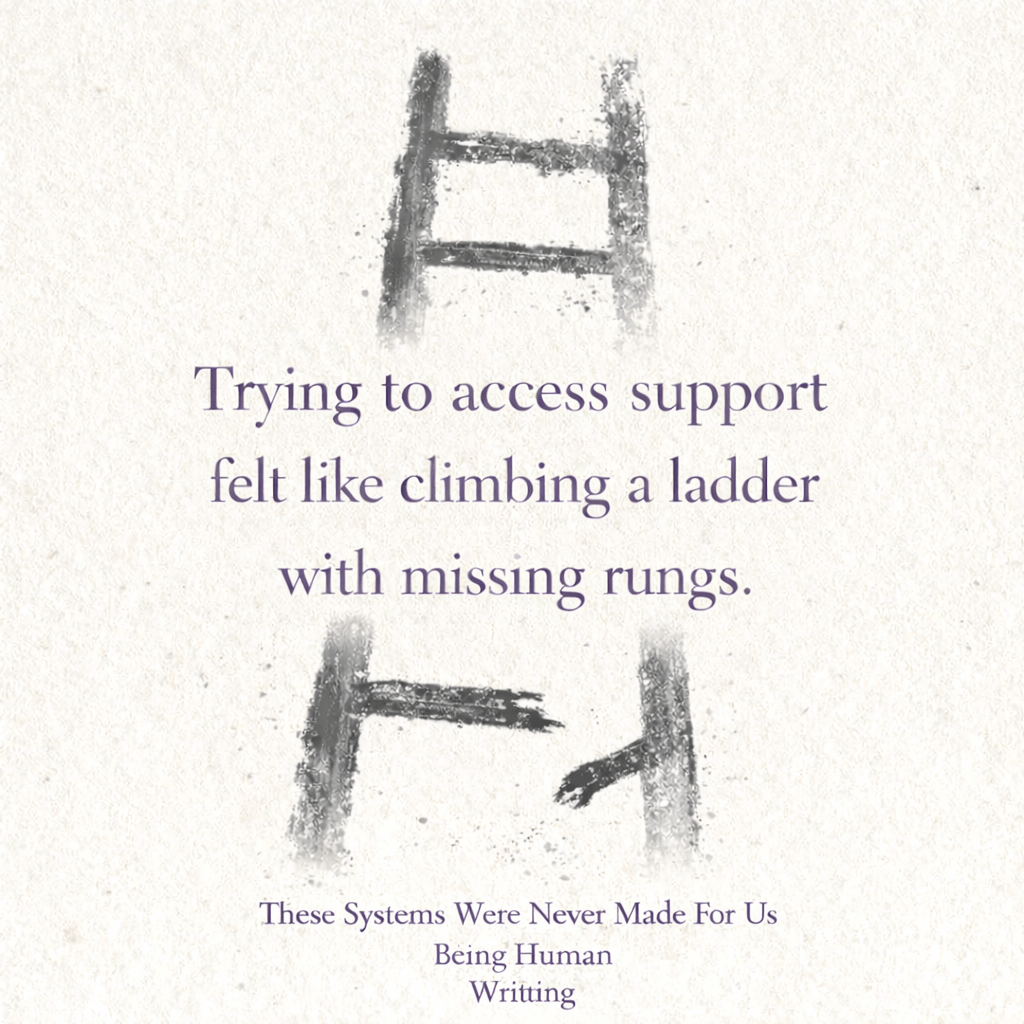
But trying to access them when you’re struggling, overwhelmed, exhausted, or unsure where to begin felt like trying to climb a ladder with missing rungs.
Over time, I started to understand something.
This was not just my story.
I began to see the same patterns in the people around me. Clients waiting months or years for services they desperately needed. People being told they were too complex for one program, and not severe enough for another.
I’ve even had to be the one to tell people I couldn’t help them because they lived outside the area my program serves. Not because they didn’t need support, but because the system said they were someone else’s responsibility.
The people who struggle the most rarely fit neatly into one system.
Someone living with a developmental disability who also uses substances.
Someone navigating mental health challenges while trying to stay housed.
Someone whose trauma shows up as behaviour that services are not equipped to hold.
These are the people who spend years moving between doors that never quite open.
Too complex for one service. Not severe enough for another. Referred somewhere else. Told to come back later. And eventually the system starts to tell the same story over and over again.
That the problem is the person. Not the system they are trying to survive inside.
Many of the workers inside these systems care deeply. They show up every day because they believe in helping people. They listen to stories that are heavy. They advocate where they can. They try to find creative solutions when policies leave gaps.
But caring inside a structure that was never designed for flexibility means constantly hitting walls.
Policies.
Funding restrictions.
Eligibility criteria.
Risk management protocols.
All of them quietly shaping what help is allowed to look like.
Workers learn quickly that there are things they are not supposed to see. Needs that fall outside eligibility criteria. Pain that does not fit neatly inside a diagnosis. Stories that cannot be fully written into case notes.
And sometimes, workers are forced into positions that feel impossible.
Turning people away because they live outside a catchment area. Closing files when someone misses too many appointments. Explaining waitlists to people who are asking for help right now. Or holding back tears as you tell a human being at two in the morning on a minus forty degree night that there are no beds available, not knowing if they will make it through the night alive.
Not because workers do not care. But because the system has already decided what care is allowed to look like.
It is easy to say the system is broken. Broken systems can be repaired. They can be fixed, adjusted, improved.
But sometimes the harder truth is that many of the systems meant to support people were never actually built to hold the people who need them most.
Systems built around productivity struggle to hold people whose lives are shaped by trauma. Systems built around risk management struggle to hold complexity. Systems built around efficiency struggle to hold humanity. And when those systems fail, the blame rarely lands on the structures themselves.
Instead, it lands on the people trying to survive inside them. They are called non-compliant. Too complex. Hard to serve. Not ready for help.
But survival is never organized.
“Survival is never organized.”
Healing does not happen on a schedule. And human lives do not fit neatly into policy frameworks or eligibility criteria.
Until we are willing to name that truth, we will keep trying to patch cracks in structures that were never designed to hold everyone.
And still, every day, people keep trying.
Workers continue to show up with compassion where policies leave gaps. Communities build support networks where services fall short. People hold each other up in quiet ways that will never appear in policy documents or funding reports.
Care continues to exist — not because the system makes space for it, but because people do.
Maybe the real work is not just fixing the system. Maybe it is learning how to build something better.
Something that recognizes complexity.
Something that holds people with dignity.
Something that understands that survival is never organized, and care should not depend on someone’s ability to prove they deserve it.
Maybe it also means remembering something we too easily forget — that no matter our differences, we are all part of the same community. All deserving of love, dignity, and connection.
Until then, people will continue to fall through the cracks. But they will also continue to find each other there. And sometimes, that is where real care begins — with each other.

 Being Human Writing
Leave a reply to Helen Unger Cancel reply