Written By Sarah Revie (Cuvalo)
I spend a lot of my life reading people. It’s part of my work, but it’s also something I’ve learned to do for myself. I have to read everyone, all the time, before I decide if it’s safe to share. Their tone of voice, their body language, the way they avoid eye contact. Small things that most people wouldn’t notice, but that tell me everything I need to know.
Not because I want to, but because I’ve been conditioned to for my own safety. There’s a big difference between someone who will sit with what you’re saying and someone who will try to make it smaller, simpler, easier to understand. And when you live with something that isn’t simple, that difference matters. Especially when what you’re carrying is beneath the surface, invisible.
So I pay attention. I decide, quietly and quickly, what feels safe to say. Most of the time, it isn’t much. I stop myself mid sentence and reach for something easier. “I’m just tired.” “I didn’t sleep well.” “It’s nothing.” Not because it’s true, but because it’s close enough. Because it doesn’t require translation. Because it protects me from having to explain something that doesn’t have clean edges or clear language.
There is a particular kind of exhaustion that comes from trying to make something invisible feel real to someone else. It isn’t like a broken arm, where you can point to it and say, “I can’t do this.” It’s already understood that accommodations will be made. Invisible illness doesn’t work like that.
And when you try to explain it, it doesn’t always land the way you need it to. Not just misunderstood or underestimated, but not fully believed.
After a while, you start to conserve your energy. You begin to choose when it’s worth explaining, and when it’s not. Sometimes that choice looks like silence. Sometimes you stretch the truth, because honestly, it feels easier than giving someone the whole story.
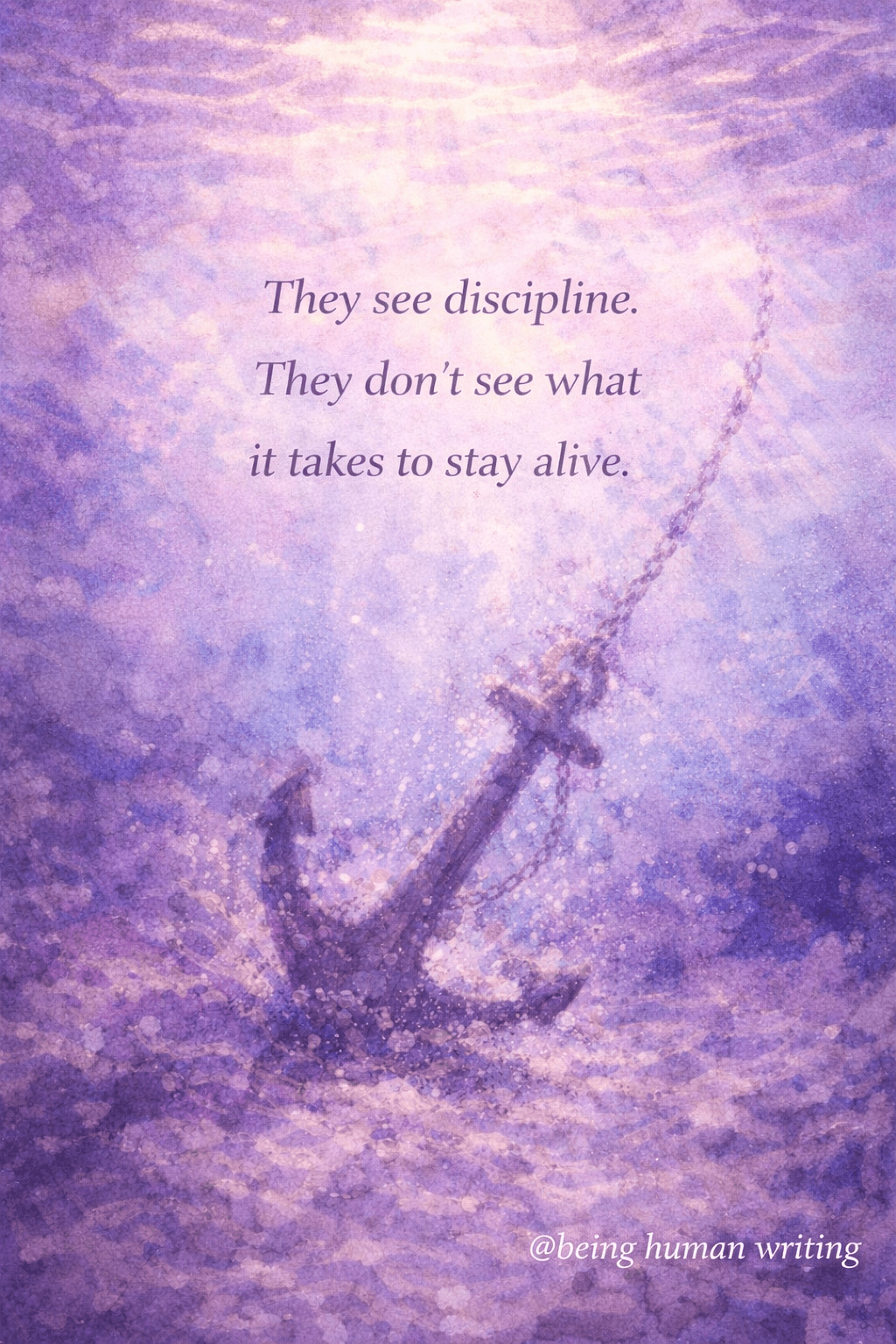
There is a particular kind of exhaustion that comes from not being believed. Not just misunderstood or underestimated, but not being believed. Invisible illness asks you to move through the world carrying something that no one else can see, while still being expected to show up as if nothing is wrong. It’s like this anchor weighing you down. No one can see it, but it’s there, always beneath the surface.
You learn quickly that the way you look matters more to people than the way you feel. If you appear well, then you must be well. If you’re functioning, then you must be fine. But that’s not how this works.
Some of us live in bodies that look exactly the way the world wants them to. Small, put together, presentable. You can go to school, hold a job, show up to things, wear the right clothes, say the right words. From the outside, there’s nothing to question. People may even think you’re impressive. Sometimes people even congratulate you. “You look great.” “You’ve lost weight.” “You’re such a hard worker.” And all you can think to say is, “thank you.”
They think they are compliments, but their words cut deep. I didn’t want to lose weight. Each pound is another added to the weight I carry. It’s not discipline or progress. It’s because there were days I just couldn’t eat, days where my body couldn’t even keep down water. Days that ended in a hospital chair, being rehydrated, trying to stabilize something that looked “healthy” from the outside.
What people don’t see is what it takes to stay alive. The tracking. The calculations. The constant awareness of food. Not because you’re trying to restrict, but because you’re trying to make sure you eat enough to stay alive. The quiet negotiations that happen in your mind every single day.
Living with an eating disorder in a smaller body means you’re constantly misread. You’re praised for the very thing you’re trying to survive. You’re told you look healthy, while you’re fighting to stay that way. You’re assumed to be in control, when in reality, you’re working every single day not to slip beneath the surface.
They only see discipline. They don’t see how close I am to drowning.
That’s not to say the people in my life don’t try. They really do. I can see it in the way they ask questions, in the way they check in, in the way they try to adjust. But I can also see the other part. The part they try to hide. The part that wishes I was “normal.”
So I keep reading people, and I can always tell. The disappointment doesn’t come out loud. It shows up in small ways. A pause that lasts a little too long. A look that shifts just slightly. An energy in the room that changes when I say no, or when I can’t stay, or when I can’t eat.
The disappointment reads like something unspoken but understood. A quiet kind of grief for the version of me they wish they had. And once you notice it, you can’t unnotice it.
Because in their minds, illness has a look. Struggle has a look. If you’re not visibly falling apart, then you must not be struggling that much. If you’re still showing up, then it can’t be that bad, even if showing up is the only thing you can manage and you’re not sure how you’re going to make it through the rest of the day.
What people don’t see is what happens after. They don’t see that showing up for an hour can take days, sometimes weeks, to recover from. They don’t see the exhaustion that follows, the mental and physical toll of pushing past your limits just to appear okay. They don’t see the cost.
Like when I cancel dinner, even though I’ve already cancelled the last eight weekends in a row, I know how it looks. Or when I back out of plans with my family, even when I was the one who made them. I’ve sat in my bathroom alone and cried more times than I can count, wishing I was “normal,” wishing I could experience life the way I want to, the way they want me to.
Or when I can see my partner getting frustrated because I want to eat the same thing again, and they just want a real meal. My mind starts racing. Do I let him choose and risk not being able to eat at all, or do I hold my ground so I can get something down? Do I suggest ordering from two different places?
Sometimes I imagine what my life would look like if I didn’t struggle with something as simple as food. The version of me who can go on a work trip and stay the whole time, who can eat with coworkers instead of alone in my car, who can attend evening events and enjoy herself. I think about her often, and I grieve her, because that version of me isn’t, and may never be, my reality.
If my family only knew how badly I want to be there. At dinners, at barbecues, at gatherings. I love them. I love being around people. I get so damn lonely.
But when people don’t understand, I can’t rely on them to advocate for me. I can’t guarantee I’ll feel safe or that I’ll be able to eat.
So sometimes I don’t go. And from the outside, that can look like disinterest, like distance, like I’m choosing not to show up. But that’s not what’s happening.
This is the weight of invisible illness. It isn’t just the symptoms themselves, but the constant negotiation between your internal reality and the external expectations placed on you. It’s the effort it takes to be believed, and the silence that often follows when you’re not. Over time, that silence does something to you. It starts to shape how you see yourself, until eventually, it begins to dictate your worth.
You start to question yourself, why someone would want to be with you, to love you, to put effort into you when you can’t guarantee you’ll always be able to give that back. It’s exhausting. It leaves you wondering if people would be better off without you, even when your loved ones tell you otherwise. It can be hard to believe them, because you can see it, you can feel it, no matter what they say.
If you’re new to this, you hide these feelings. You bury them until they start to feel like truth. You tell yourself you can push through, that you can make it to dinner, that you can show up for them, and sometimes you believe it.
Then it hits you harder. When you overextend. When you do something you already knew you didn’t have the capacity for. When it takes you days, sometimes weeks, to recover. Sometimes it feels worth it. Other times, it feels like a mistake you have to pay for.
If you’ve been living with this for a while, like I have, something shifts. You learn to say no when you need to. You learn to be softer with yourself. But you don’t get there without first pushing too far, without learning, often the hard way, what your body will and will not tolerate. Without disappointing the people you love, who miss you, who just want to spend time with you.
You start to share with the people who take the time to try to understand, even if they never fully get it. Because to truly understand, you have to live through it, and most people haven’t.
And if you’re someone trying to support a person like me, I want you to know that we’re not asking for perfection. We’re not asking you to fix it.
We’re asking you to listen. To believe us when we say something is hard, even if you can’t see it. To not measure our experience by how we look on the outside.
Support doesn’t look like pushing us past our limits so we can be “normal.” It looks like sitting with us inside them. It looks like being flexible, even when it’s inconvenient. It looks like understanding that showing up might look different for us, and that different doesn’t mean less.
Support looks like holding us while we cry because we are so damn frustrated with ourselves. It’s taking the time to learn how to advocate for us properly when we don’t have the energy. It’s setting boundaries with friends and family, and not guilting us for not having the capacity to do the things you want us to do. It’s knowing when to remind us that we are humans worthy of love when we forget it.
It can be as simple as meeting us where we’re at, without making us feel like a burden for needing things to be a certain way.
And maybe most importantly, it looks like not taking it personally when we can’t show up the way you hoped we would. Because we want to be there. More than you know.
We’re already carrying something heavy. We’re not asking you to take the weight away. Just don’t ask us to pretend it isn’t there.
And to the ones learning how to take up space in a world that tells them to be quiet about their pain. To the ones who feel undeserving of love because they are fighting something every single day. I see you.
You are not too much.
You are not failing.
You are carrying something that most people will never fully understand.
So if you are carrying something invisible, and you feel the weight of not being believed, I want you to hear this clearly. Your experience is real. Even if it does not look the way people expect it to, even if you appear fine, even if you are the only one who fully understands what it takes just to get through a day.
You are allowed to define what enough looks like for you.
Because sometimes, the strongest thing you can do is live honestly inside your limits, in a world that keeps asking you to ignore them.
 Being Human Writing
Leave a comment